
Blog
Hidden hearing loss : Why You Struggle to Hear?

Hidden hearing loss and what we can do about it
Hidden hearing loss—
clinically known as cochlear synaptopathy — is damage to the nerve synapses that carry sound signals from your inner ear to your brain. You can pass a hearing test with flying colors and still struggle every single day to follow a conversation in a noisy room. Researchers now believe it affects tens of millions of people, and most of them have no idea.
Every May, Better Speech and Hearing Month gives us a chance to talk about the stuff most people are quietly dealing with but never bring up — and this year, the topic that stopped us in our tracks here at Excel Audiology in Royal Oak is something the research community has only started to fully understand in the last decade. You probably think of hearing loss as something you notice gradually — voices getting muddier, the TV volume creeping up, people starting to sound like they’re mumbling. But there’s a version of hearing loss that flies completely under the radar of conventional testing, and it might already be happening to you right now.
What exactly is happening inside your ear when you have hidden hearing loss?
Inside your cochlea — the snail-shaped structure in your inner ear — there are thousands of tiny hair cells that pick-up sound vibrations. A standard hearing test checks whether those hair cells are alive and working. Hidden hearing loss is different: the hair cells are fine, but the synapses connecting them to the auditory nerve start to silently degrade. Think of it like a telephone with a perfect microphone and a fraying wire — the input is there, but the signal doesn’t make it to the other end cleanly.
(This is different from Auditory Processing Disorder (APD) where the difficulty lies in processing the auditory signal in the brain.)
This is why so many people feel genuinely confused when they get a “normal” hearing test result but still feel like they’re constantly asking people to repeat themselves, especially in noisy places like restaurants or family gatherings. Their audiogram is measuring the wrong thing. The problem isn’t detecting a tone in a quiet room — it’s the brain struggling to decode fast, complex speech in noisy environments. That’s a neural problem, not a hair-cell problem, and it requires a different kind of evaluation to catch it.
Who is most at risk for Hidden Hearing loss — and why does it matter for your brain?
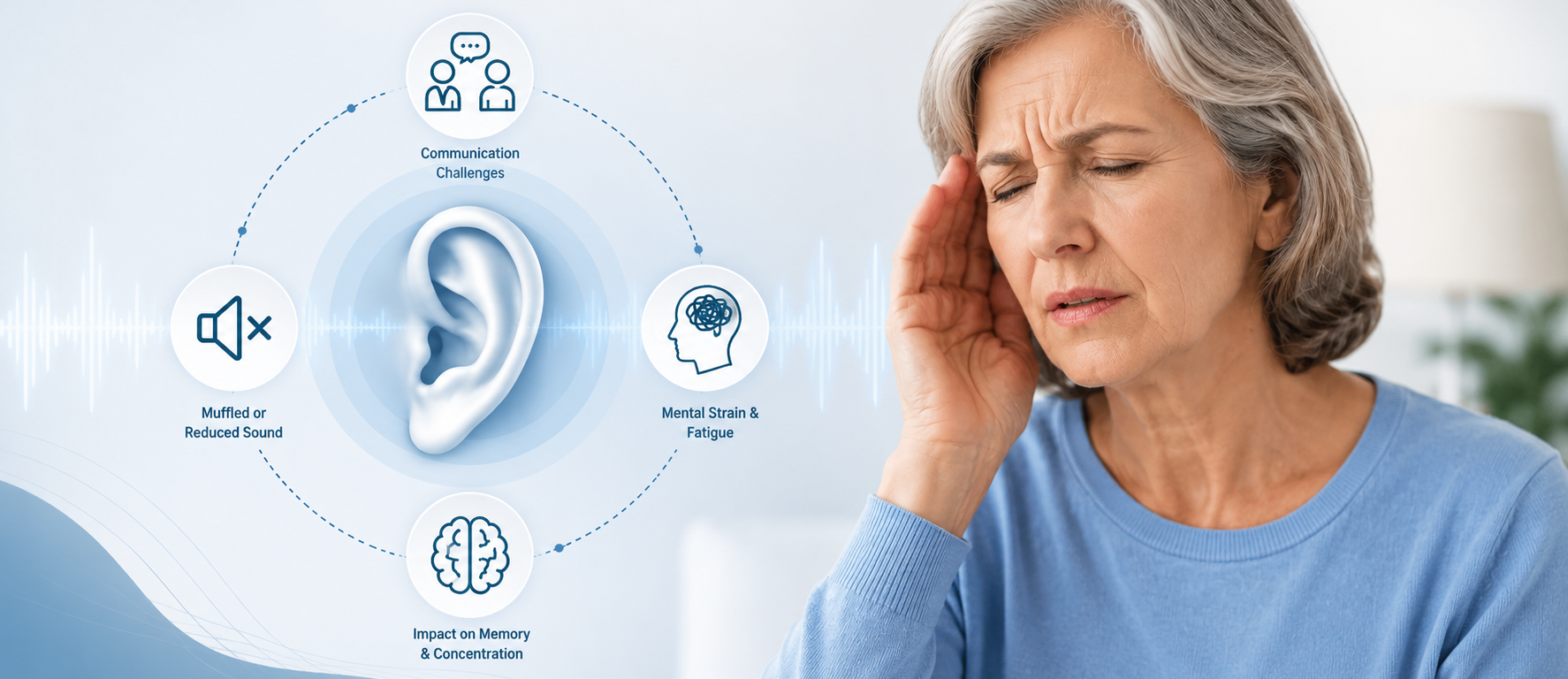
Anyone with a history of noise exposure is at elevated risk — concerts, sporting events, earbuds at high volume, noisy workplaces, even years of recreational gunfire without protection. But here’s the part that should genuinely alarm people: researchers now believe that synaptopathy is a major mechanism behind the well-established link between hearing loss and cognitive decline. When the auditory nerve sends a degraded signal, the brain has to work harder to fill in the gaps — and that extra cognitive load, sustained over years, is increasingly associated with accelerated memory loss and a measurably higher risk of dementia.
Published neuroscience shows why getting a proper evaluation matters far more than most people realize. The ear is not just a sound-collecting device. It’s a direct pipeline into one of the most complex systems in the human body, and what happens in the cochlea doesn’t stay in the cochlea. Untreated hearing loss has been connected to reduced lifespan, higher rates of social isolation, depression, and now — through the synaptopathy pathway — an earlier cognitive trajectory than your peers who addressed their hearing health proactively.
What can actually be done about hidden hearing loss right now?
The most important first step is getting a comprehensive audiologic evaluation — not just the quick tone test. A full evaluation can include speech-in-noise testing, which mimics real-world conditions and reveals the gap between what your ears detect and what your brain successfully processes.
In addition, a thorough review of symptoms and patient history would also help in arriving at the diagnosis of Hidden Hearing Loss.
Modern Bluetooth-enabled, rechargeable hearing aids with advanced noise-processing algorithms can dramatically reduce the brain’s processing burden by cleaning up and amplifying sound before it reaches damaged pathways when they identify hidden hearing loss.
>Listening therapy and auditory training, when utilized in addition to hearing aids, may allow your brain to adapt and enhance its sound-processing capabilities.
The other piece of the puzzle is protection going forward. Custom earplugs aren’t just for construction workers — musicians, concert-goers, motorcyclists, and anyone regularly exposed to noise above 85 dB can meaningfully slow the progression of synaptopathy by wearing them consistently. Think of it the same way you’d think about sunscreen for your skin: you can’t undo the damage that’s already there, but you absolutely can stop adding to it.
For questions regarding testing, custom noise plugs or hearing aids call us at 248-549-9035