
Diagnostic Audiologic Evaluations
Introduction to Diagnostic Audiologic Evaluation
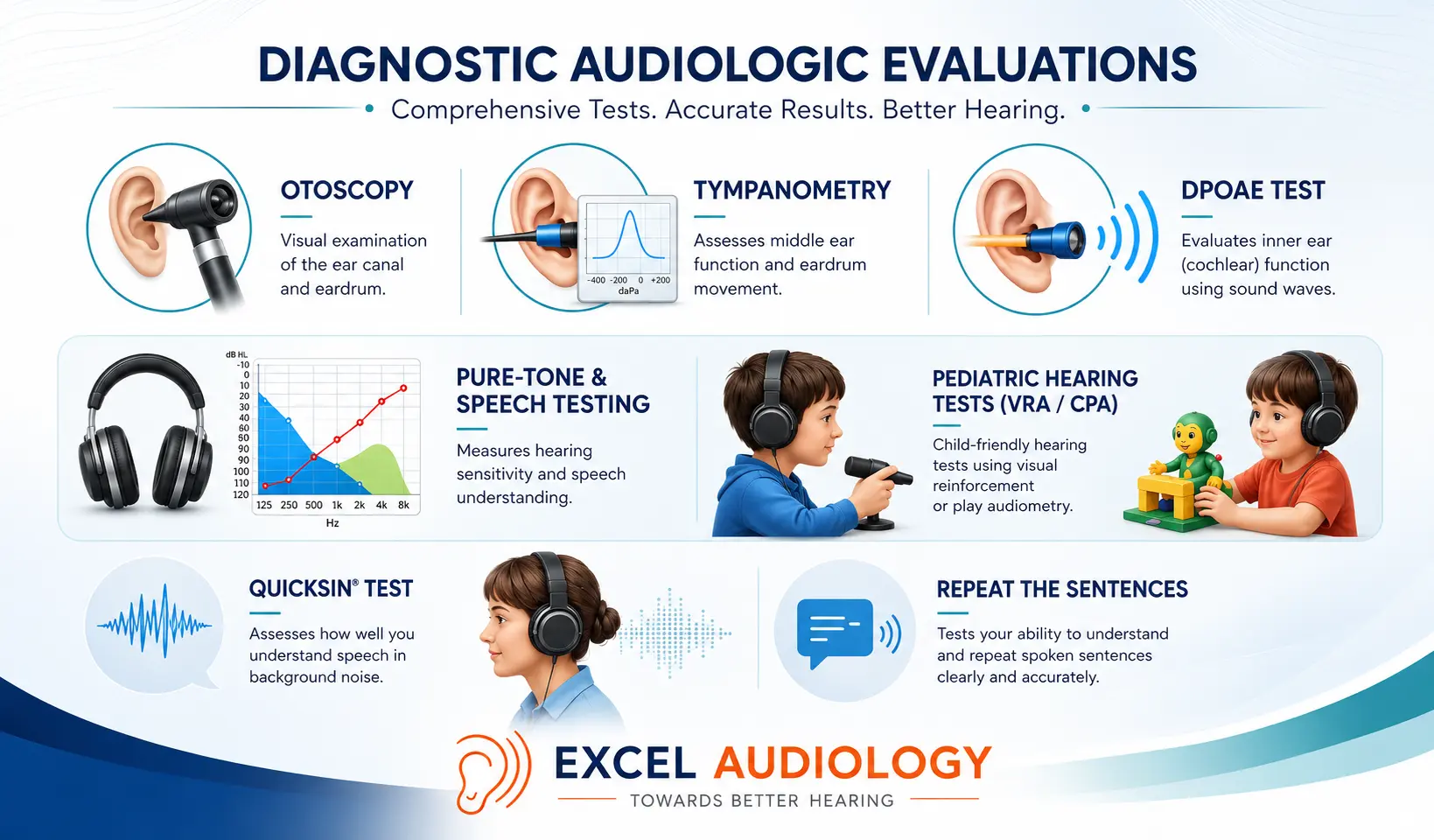
A diagnostic audiologic evaluation is a comprehensive hearing test that combines otoscopy, tympanometry, otoacoustic emissions (OAE), pure-tone audiometry, and speech testing to pinpoint the type, degree, and cause of hearing loss.
At Excel Audiology in Royal Oak, MI, a licensed CCC-A audiologist performs the full evaluation in one visit, typically in under an hour, and uses the results to guide next steps — whether that’s monitoring, medical referral, or hearing aid fitting.
What Actually Happens During a Hearing Test?
If you’ve never had a proper hearing evaluation, the term “diagnostic audiologic evaluation” probably sounds more intimidating than it is. Here’s the honest version: it’s a series of quick, painless checks that tell your audiologist exactly what’s going on with your ears — not just whether you’re missing sounds, but where the problem is coming from and why.
More than 25 million American adults over age 12 live with some degree of hearing loss, and it affects roughly 1 in 5 kids at some point before age 18. Most people wait years before getting tested. That delay matters — the sooner you know what’s happening, the more options you have.
Step 1: Otoscopic Exam
Your audiologist starts by looking inside your ear canal with an otoscope. This simple visual check rules out the obvious stuff first — earwax buildup, fluid, infection, or a perforated eardrum — before moving on to the more detailed testing.
Step 2: Tympanometry — Checking Middle Ear Pressure
Tympanometry measures how your eardrum moves in response to air pressure changes. It’s fast (about 5 seconds per ear) and tells your audiologist whether your middle ear is functioning normally or whether something like fluid or a pressure imbalance might be affecting your hearing.
Step 3: DPOAE Testing — Inner Ear Function
Distortion Product Otoacoustic Emissions (DPOAEs) test how well the tiny hair cells in your cochlea are working. A soft probe plays sounds into the ear, and the machine “listens” for the faint echo that hair cells produce naturally. It’s an objective test, meaning it doesn’t rely on you pressing a button — which makes it especially useful for testing infants and toddlers.
Step 4: Pure-Tone Audiometry — Finding Your Hearing Thresholds
This is the test most people picture: sitting in a sound booth, wearing headphones, raising a hand or pressing a button when you hear a beep. Pure-tone testing measures the softest sound you can detect at different pitches, through both air conduction (headphones) and bone conduction (a small vibrating device behind the ear).
Why it matters: comparing air and bone conduction results tells your audiologist whether hearing loss is conductive (a mechanical issue in the outer or middle ear — often treatable) or sensorineural (nerve-related, usually permanent and managed with hearing aids).
Step 5: Speech Testing — Beyond Just “Hearing” Sound
Detecting a beep and understanding a conversation are two different skills. Speech testing checks how clearly you can identify words at a comfortable volume. This step is what actually predicts how well hearing aids will help you in real life, and it helps your audiologist recommend the right technology level for your specific needs.
The QuickSIN Test: Hearing in the Real World
Here’s the test people don’t talk about enough. QuickSIN (Quick Speech-in-Noise) plays sentences against realistic background noise — the kind you’d deal with at a restaurant or family gathering — and measures how much noise you can tolerate before speech understanding falls apart.
A lot of patients pass a quiet-room hearing test but still struggle at dinner parties. QuickSIN explains why, and it’s one of the most useful real-world predictors an audiologist has.
Testing for Infants and Toddlers
Little ones obviously can’t raise a hand on cue, so pediatric testing looks different. Excel Audiology uses Visual Reinforcement Audiometry (VRA) — pairing a sound with a fun visual reward like a lit-up toy — for babies and young toddlers, and Conditioned Play Audiometry (CPA) — turning the response into a game, like dropping a block in a bucket — for slightly older kids. Both happen in a sound-field room and are designed to feel like play, not a medical procedure.