
Hearing Tests in Royal Oak, MI: What to Expect, What It Costs, and Why It Matters
Hearing Tests in Royal Oak, MI: What to Expect, What It Costs, and Why It Matters
Most people put off a hearing test for years — blaming bad acoustics, mumbly talkers, or earwax. The truth is, getting tested is a 30-45-minute appointment that can genuinely change how you experience the world. The earlier you catch hearing loss, the more options you have — including options that don’t involve hearing aids at all.
At Excel Audiology, 32121 Woodward Ave Suite 203, Royal Oak, MI, audiologist Smita Singh has been conducting thorough diagnostic evaluations since 2002. Here’s exactly what to expect.
How Do You Know If You Need a Hearing Test?
Book an evaluation if you regularly ask people to repeat themselves, struggle in noisy places, hear voices but can’t make out the words, turn the TV louder than others prefer, or have ringing in your ears (tinnitus). Adults over 50 should get a baseline evaluation even without obvious symptoms — research increasingly links untreated hearing loss to cognitive decline.
What Happens During a Hearing Test?
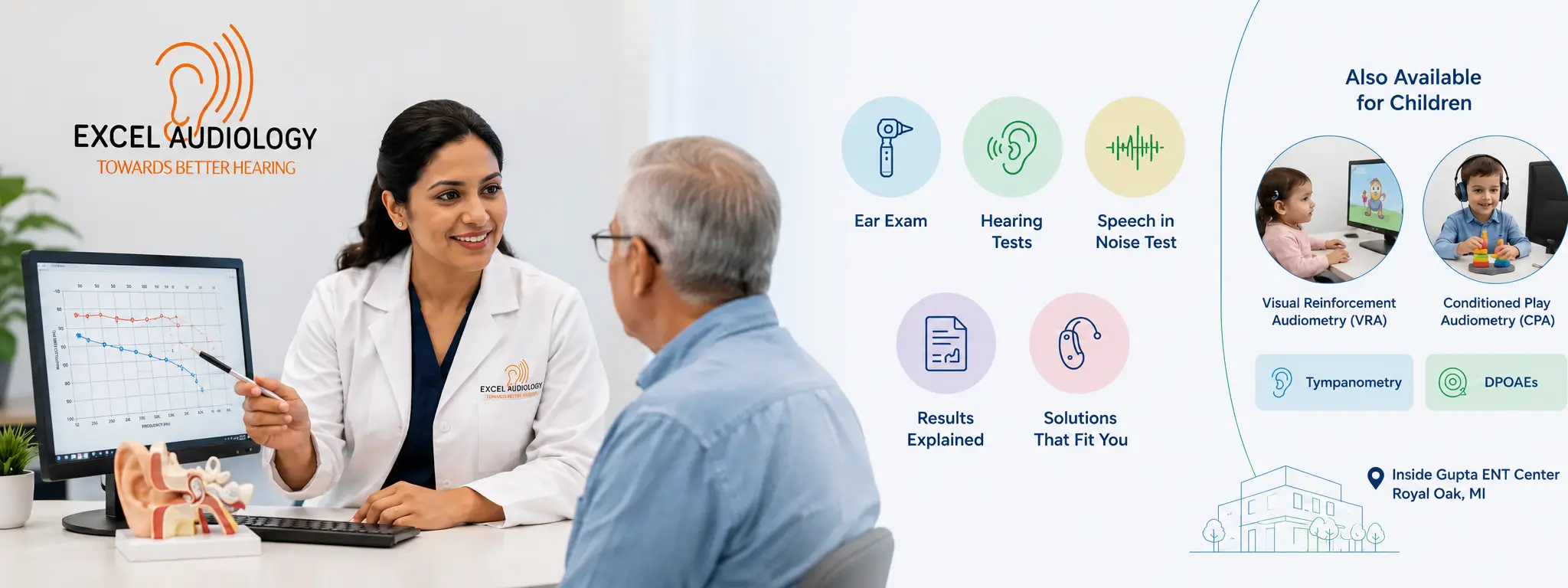
A full diagnostic audiologic evaluation at Excel Audiology covers six assessments in a single visit:
- Otoscopic Exam Visual check of the ear canal — sometimes the culprit is simply wax buildup.
- Tympanometry Measures middle ear pressure to detect fluid, infection, or eardrum problems.
- OAE Test (DPOAEs)Checks inner ear hair cell function — catches cochlear damage before it becomes severe. Distortion Product Otoacoustic Emissions (DPOAEs) are sounds generated by the inner ear (specifically the outer hair cells of the cochlea) in response to two tones played into the ear. DPOAE testing is commonly used to evaluate cochlear function and screen hearing, especially in infants and children.
- Pure-Tone Audiometry Soundproof booth testing that maps hearing across all speech-critical frequencies.
- Speech Testing Measures how clearly you distinguish words — key to deciding whether hearing aids would help and at what technology level.
- QuickSIN (Speech-in-Noise) Tests real-world understanding when background noise is present — the scenario that brings most patients in Michigan.
What Happens After the Test?
Smita walks you through your audiogram in simple terms then discusses your options —whether it’s monitoring your hearing, or hearing aid fitting, or tinnitus treatment, or a medical referral.
Excel Audiology carries Oticon, Phonak, ReSound, and Signia across a range of budgets and styles. Excel Audiology is located within Gupta ENT Center, where Dr. Gupta examines the patients with medical perspectives to determine if hearing can be medically reversed. So you will get the benefit of seeing an audiologist and ENT in one single visit.
📋 Also Available for Children
Smita tests infants and toddlers using Visual Reinforcement Audiometry (VRA) and Conditioned Play Audiometry (CPA) — techniques designed for young patients who can’t follow standard hearing test instructions. In addition, Tympanometry and Distortion Product Otoacoustic Emissions (DPOAEs) are also carried out to assess the hearing of infants and toddlers
Visual Reinforcement Audiometry (VRA) is a behavioral hearing test used mainly for infants and young children (typically 6 months to about 2–3 years old). It checks how well a child can hear by training them to respond to sounds with a head turn
Conditioned Play Audiometry (CPA) is a behavioral hearing test used for young children, usually between 2 and 5 years old. It turns hearing testing into a simple game so children can actively participate.