
Communication Strategies for the Hearing Impaired
Communication Strategies for the Hearing Impaired
Hearing loss affects more than 430 million people worldwide, according to the World Health Organization. Despite these numbers, most people have never been taught how to adjust the way they communicate.
The result? Frustration on both sides. The person with hearing loss feels left out. The person speaking feels helpless.
The good news is that effective communication with someone who is hard of hearing does not require any special training. It requires awareness and a few small habits. This guide walks you through 10 evidence-based communication strategies used by audiologists and hearing health professionals every day.
10 Communication Strategies for Talking to Someone with Hearing Loss
-
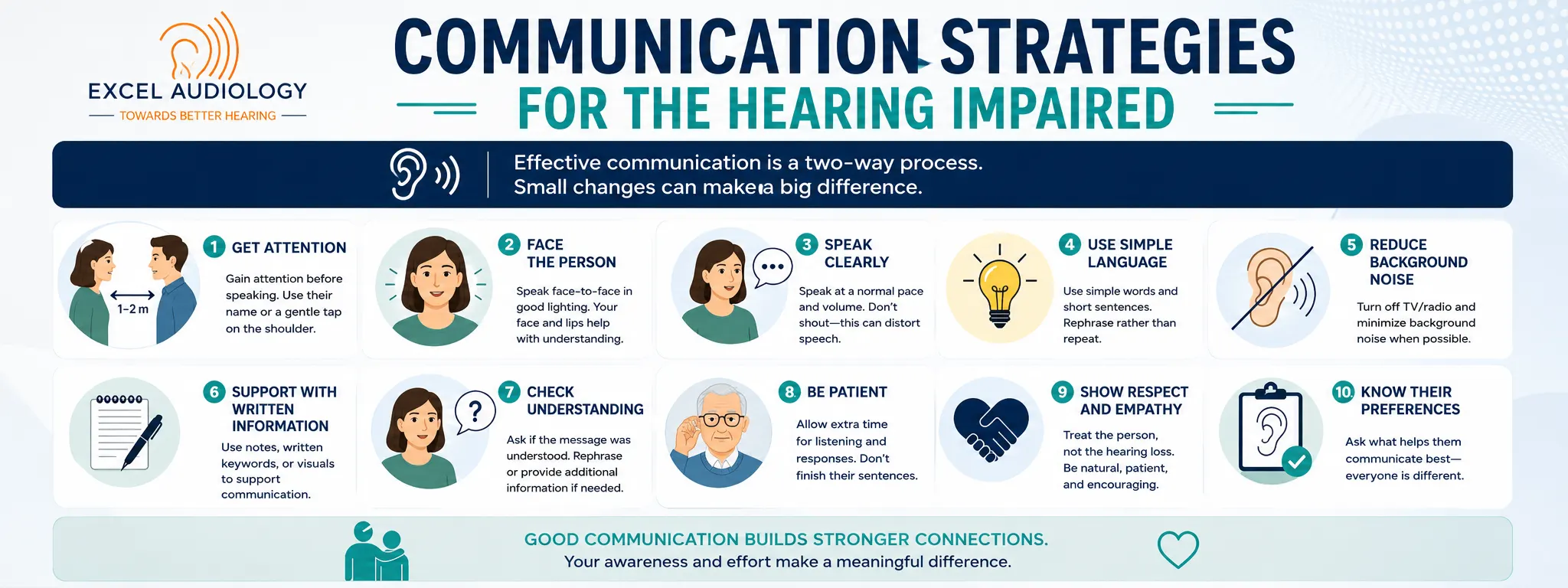
Get Their Attention Before You Start Speaking
This one sounds obvious, but it is overlooked constantly. Starting a conversation before a person with hearing loss knows you are talking to them means they miss the first few words — and sometimes the entire context of what you are saying.
Before you speak, say their name, make eye contact, or gently tap their shoulder. Give them a moment to turn and focus. This small step eliminates one of the most common communication breakdowns.
-
Always Face the Person Directly
Speaking face-to-face in good lighting is one of the most powerful tools you have. People with hearing loss — even those who have never formally learned lip reading — use visual cues from your mouth, face, and expressions to fill in what their ears miss.
This means: no talking from another room, no speaking while your back is turned, and no covering your mouth while you speak. Sit or stand at their level. Make sure light is on your face, not behind you.
-
Speak Clearly at a Normal Pace and Volume
Many people instinctively speak louder when talking to someone with hearing loss. This is actually counterproductive. Shouting distorts the shape of words and can come across as rude or condescending.
Instead, slow down slightly, articulate your words clearly, and keep your volume normal to moderately raised. Think of it as speaking the way you would during a presentation — deliberate, but natural.
-
Use Simple Words and Short Sentences
Long, complex sentences are harder to follow for anyone who is working to decode what they hear. Use short, direct sentences. Avoid stringing multiple ideas together with “and,” “but,” and “so.”
If you are not understood, rephrase rather than repeat. Saying the same words again — even louder — rarely helps. A fresh way of expressing the same idea often does.
-
Reduce Background Noise Wherever Possible
Background noise is the single biggest barrier to communication for people with hearing loss. A television in the background, music playing, or a crowded restaurant can make a conversation nearly impossible even for someone wearing hearing aids.
Turn off the TV or radio. Move to a quieter space if you can. Choose seating away from speakers or kitchen noise when eating out. These environmental adjustments cost nothing and make a significant difference.
-
Support Your Words with Written Information
Writing down key information — an address, a name, a date, a medication dosage — removes any risk of misunderstanding. You do not have to write entire conversations. Just anchor the important details on paper or on your phone screen.
Visual supports like diagrams, maps, or printed instructions are especially helpful in medical or professional settings where accuracy matters.
-
Check That Your Message Was Understood
Do not assume silence means understanding. After sharing important information, ask a gentle follow-up: “Does that make sense?” or “Would you like me to go over any part of that again?”
If there was a misunderstanding, rephrase or add context. This is not about talking down to someone — it is about closing the loop and making sure communication actually happened.
-
Be Patient and Allow Extra Time
Conversations with someone who has hearing loss may take a little longer. That is completely normal. Allow time for them to process what was said and to form their response. Do not finish their sentences, rush them, or change the subject before they have had a chance to respond.
Patience is not just a courtesy — it is a communication strategy. When people feel rushed, they are more likely to guess rather than ask for clarification, which leads to bigger misunderstandings later.
-
Show Respect and Empathy
Hearing loss is a medical condition, not a personality trait. Treat the person in front of you — not their hearing loss. Avoid saying things like “never mind, it’s not important” when they ask you to repeat yourself. It is always important if they ask.
Be natural. Be encouraging. Do not speak about them to others in the room as if they are not there. Dignity and respect are the foundation of every good communication exchange.
-
Ask What Works Best for Them
Every person with hearing loss is different. Some rely heavily on lip reading. Others find written notes most useful. Some use hearing aids or cochlear implants that work well in quiet settings but struggle in noise. Some prefer phone calls; others prefer text messages.
The single most helpful thing you can do is ask: “What helps you communicate best?” Then listen — and adjust accordingly.
Take the Next Step with Excel Audiology
At Excel Audiology, we believe that better hearing leads to better living. Whether you are someone living with hearing loss or a family member who wants to support a loved one, our experienced audiologist is here to help.
We offer comprehensive hearing evaluations, the latest hearing aid fitting and counseling services, and ongoing support for all stages of hearing health — from early detection to long-term management.
Why choose Excel Audiology?
Our audiologist does not just fit hearing devices — she guides you through every aspect of communication, from choosing the right technology to teaching communication strategies tailored to your lifestyle. We work with children, adults, and seniors, and we understand that no two patients are the same.
If you or someone you love is struggling with hearing loss, do not wait. The earlier hearing loss is identified and managed, the better the outcomes for communication, relationships, and overall wellbeing.
Call 248-549-9035 to schedule complete evaluation towards better hearing.
Because every conversation deserves to be heard.