
Types of Hearing Loss
Types of Hearing Loss
If you have had a hearing test and been told you have a hearing loss, the first question to ask is
what kind of hearing loss. The outcomes and the solutions will depend on the type of hearing loss you have been diagnosed with. Here are the different types:
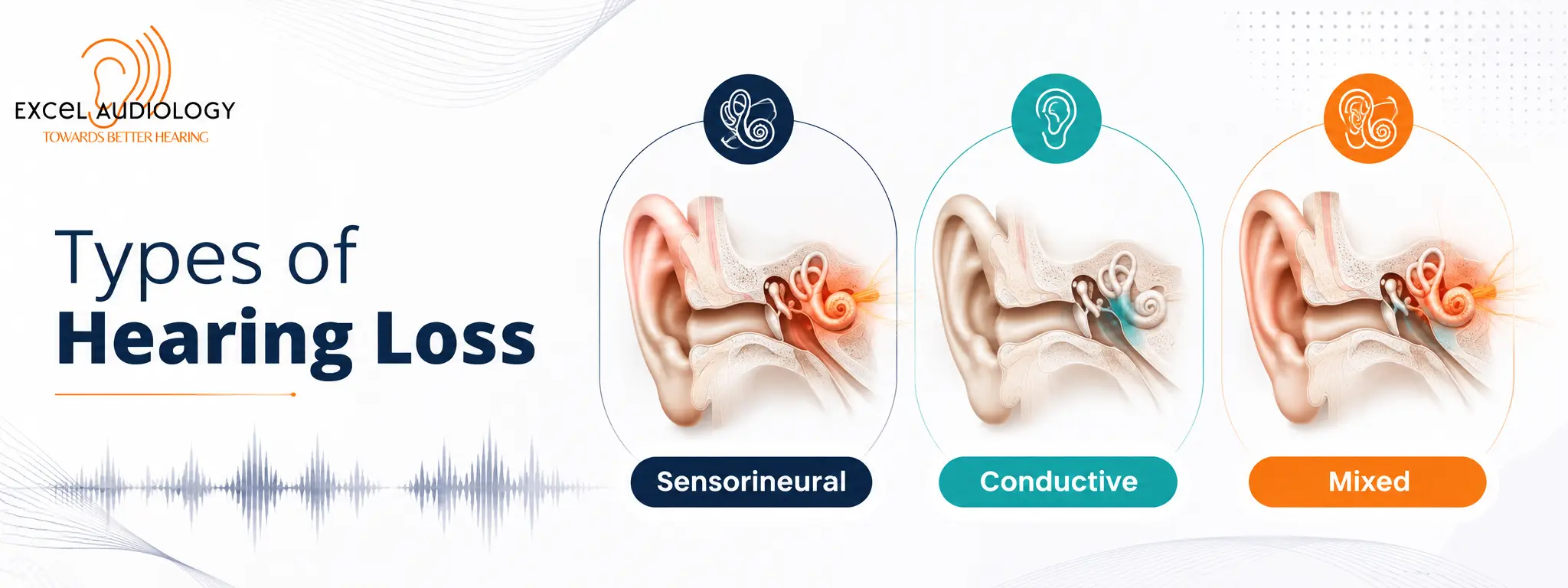
Sensorineural Hearing Loss: The Most Common Type
Sensorineural hearing loss (SNHL) happens when the tiny hair cells in the cochlea, or the auditory nerve itself, get damaged. Once those cells are gone, they grow back — which is
why this is the type of hearing loss most people end up managing long-term rather than curing.
What causes it:
Natural aging (presbycusis)
Long-term exposure to loud noise — concerts, machinery, headphones cranked too high
Ototoxic medications
Illness, head injury, or genetics
In children, its present in roughly 6 out of every 1,000 births, and congenital cytomegalovirus (CMV) is one of the leading preventable causes
There is no surgery that reverses SNHL, but that doesn’t mean nothing works. Modern hearing aids do a remarkable job of restoring clarity for most people, and for severe to profound loss where hearing aids fall short, cochlear implants are worth discussing with an audiologist. If you have concerns regarding your hearing, Diagnostic Audiologic Evaluation is the starting point —
it tells you exactly which frequencies are affected and how much they are affected, so any recommendation is based on your diagnosis.
Conductive Hearing Loss: Often Fixable
Conductive hearing loss is a mechanical problem — sound physically can & get through the outer or middle ear to reach the cochlea. Think of it like a clogged pipe rather than a broken one.
Common culprits:
Earwax buildup or something lodged in the ear canal
Fluid from an ear infection (extremely common in kids)
A perforated eardrum
Otosclerosis or other bone abnormalities in the middle ear
Structural issues present from birth, like atresia
The encouraging part: a lot of conductive hearing loss is temporary and responds well to medication, wax removal, or minor surgery. Left undiagnosed in children, though, even short- term conductive loss can interfere with speech and language development, which is why recurrent ear infections in kids should not be ignored. Schedule pediatric or adult hearing tests to determine the type of loss you a experiencing.
Mixed Hearing Loss
Mixed hearing loss is exactly what it sounds like — a combination of sensorineural and conductive components at the same time. Someone might have age-related sensorineural loss and then develop a middle-ear infection on top of it, temporarily making things worse.
Treatment usually addresses the conductive piece first (since that part may be reversible), then manages the sensorineural piece with amplification, such as hearing aid fitting and selection.
Two Lesser-Known Categories
Central hearing loss: Damage or impairment isn’t in the ear at all — it in the auditory
pathways or centers of the brain. This is rare compared to the types above.
Central auditory processing disorder (CAPD): Hearing is technically normal on a standard test, but the brain struggles to process and interpret speech and sound. This is
often confused with hidden hearing loss — read more on that here.
Why the Type Matters More Than the Symptom hear well & quote; can mean five completely different things depending on the mechanism
behind it — and the treatment path changes entirely based on which one it is. That’s the whole reason a proper diagnostic evaluation matters more than an online hearing quiz.
Left untreated, hearing loss of any type has been linked to broader health risks, including cognitive
decline — something we’ve covered in more detail in the link between untreated hearing loss and dementia and how untreated hearing loss can affect your lifespan.
When to See an Audiologist
Book an evaluation if you notice:
Asking people to repeat themselves regularly
Turning the TV up louder than others prefer
Muffled hearing after a cold, flu, or ear infection
Ringing or buzzing in the ears (tinnitus)
A child not responding consistently to sounds or speech